Project Summary
FarmLink is a digital marketplace designed to connect smallholder farmers directly with consumers and retailers. The platform aims to reduce reliance on middlemen, improve price transparency, and simplify logistics through a streamlined digital ecosystem that includes product listings, delivery coordination, and produce traceability.

MY ROLL
Product Designer
Duration: 4–6 weeks (example)
Tools: Figma, Miro, FigJam, Chat gpt
The Reality
Smallholder farmers often depend on intermediaries to sell their produce, losing a significant portion of their profits. At the same time, consumers face high prices, inconsistent quality, and limited visibility into where their food comes from.
The agricultural supply chain is fragmented, inefficient, and lacks transparency.
Problem Statement
Smallholder farmers often rely on intermediaries to sell their produce, which significantly reduces their profits and limits their access to larger markets. At the same time, consumers face challenges in verifying the quality and origin of the food they purchase.
Additionally, inefficient logistics systems and limited digital access in rural areas make it difficult for farmers to connect directly with urban buyers.
These challenges create an inefficient supply chain where farmers earn less while consumers pay more.
Solution Provided
The proposed solution is a digital marketplace platform that connects farmers, consumers, and transporters within a single ecosystem.
Farmers can list their produce before harvest, allowing consumers and retailers to discover and purchase directly from them. The platform provides transparent pricing, automated payment processing, and logistics matching to streamline delivery.
Consumers can track produce origins through QR codes and receive real-time updates during delivery. Meanwhile, transporters are matched with delivery requests through a gig-style logistics system that optimises routes and reduces transportation costs.
To ensure accessibility for rural farmers, the platform includes agent-assisted onboarding, SMS notifications, and local language support.
By integrating marketplace access, logistics coordination, and traceability features, the platform aims to build trust, reduce inefficiencies, and create a more equitable agricultural supply chain.
Project Goals
The goal of this project is to design a user-friendly digital marketplace that connects farmers directly with consumers while addressing key barriers in the agricultural supply chain.
The platform aims to:
• Enable farmers to sell produce directly to consumers and retailers
• Improve price transparency and fair income opportunities for farmers
• Provide consumers with traceable and fresh farm produce
• Simplify logistics and transportation of agricultural products
• Support farmers with limited digital literacy through simplified interfaces and agent support systems
Ultimately, the solution seeks to create a more transparent, efficient, and inclusive agricultural marketplace.
UX Research Methods
To better understand the challenges within the agricultural supply chain, a combination of qualitative and secondary research methods was used. The goal was to identify the needs, behaviors, and pain points of farmers, consumers, and logistics providers.
The research focused on three key areas: how farmers currently sell their produce, how consumers source fresh food, and the logistical challenges involved in transporting agricultural products.
The research methods included:
• Secondary Research: Reviewing reports and articles on agricultural supply chains, digital marketplaces, and agri-tech solutions.
• User Interviews (Hypothetical): Understanding the daily experiences of farmers and food buyers in sourcing and selling produce.
• Competitor Analysis: Studying existing platforms that connect farmers with buyers or provide agricultural logistics services.
Insights gathered from these research methods helped define the core problems and informed the key features included in the platform design.
AI for Research Synthesis
To enhance research depth and efficiency, I integrated AI-assisted tools throughout the design process. Instead of replacing traditional UX methods, AI was used to augment insights, validate assumptions, and explore solution options more effectively.
AI played a key role in analyzing large data sets, recognizing patterns, and generating design alternatives, enabling quicker iteration and more informed decisions.
g
Key User Insights
After AI analyzed the needs of farmers, consumers, and transporters, several insights emerged:
-
Farmers Need Market Visibility. Many farmers lack access to real-time market prices and reliable buyers.
-
Logistics is a Major Barrier. Even when farmers find buyers, transporting produce efficiently remains difficult.
-
Trust Is Essential. Consumers want assurance about where their food comes from and how it was handled.
-
Digital Access Varies Widely. Not all farmers have smartphones or digital literacy, requiring simplified solutions like sms or agent support.
User personal
AI was used to simulate user scenarios across different personas. This helped anticipate edge cases such as low-connectivity environments, delayed logistics, and incomplete transactions.
This enabled us to make proactive design decisions, such as adding SMS notifications and simplifying workflows.


How Might We” Statement
How might we design a digital platform that enables smallholder farmers to connect directly with consumers, while simplifying logistics, improving price transparency, and ensuring accessibility for farmers with limited digital literacy?
How might we reduce farmers’ dependence on middlemen?
How might we make farm produce traceable and trustworthy for consumers?
How might we simplify logistics between rural farms and urban buyers?
How might we design for farmers with limited access to smartphones?
Competitive Analysis Table
To understand the current landscape, I analyzed platforms that already support agricultural marketplaces or logistics systems.

The platform is designed with three main user flows: Farmers, Consumers, and Transporters.


Wireframes
The early wireframes focused on simplicity and accessibility, especially for farmers with limited digital experience.
Key design principles:
-
Simple navigation
-
Clear product listings
-
Visual product images
-
Minimal text complexity
Easy order confirmation
The goal was to ensure that both farmers and consumers could complete tasks quickly without confusion.
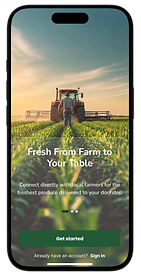


The Home Screen wireframe was designed to prioritise product discovery while maintaining a simple and intuitive experience for consumers. The layout focuses on quick access to product categories, featured farms, and seasonal harvests, allowing users to browse fresh produce with minimal effort.
Key design principles:
-
Simplified navigation for users with varying levels of digital literacy.
-
Clear visual hierarchy to guide users toward primary actions.
-
Trust-building elements such as farm verification, delivery tracking, and status updates.
-
Mobile-first layouts optimised for quick interactions and accessibility.
-
Reduced complexity to ensure a seamless experience across the entire farm-to-consumer journey.
-
These wireframes helped validate the core user flows before moving into high-fidelity designs and visual styling.


The centralised dashboard is designed to help farmers monitor their daily operations at a glance. The screen highlights new orders, active product listings, earnings, and customer ratings while offering quick actions for managing orders and updating inventory.
A streamlined product creation process allows farmers to upload produce, categorise items, set quantities, prices, and harvest dates. The layout emphasises simplicity and efficiency to minimise the time needed to publish new listings.
The wireframes were designed with a mobile-first approach, emphasizing ease of use, quick navigation, and accessibility for farmers managing products and orders while on the go. The structure highlights a clear information hierarchy, minimizes friction, and enables efficient task completion.
Key Design Principles
-
Simplicity: Clean and intuitive interface for easy navigation.
-
User Centred: Designed around farmers' daily tasks and workflows.
-
Visual Hierarchy: Highlights important information and actions first.
-
Consistency: Uniform design patterns for a seamless experience.
-
Efficiency: Reduces steps needed to manage products and orders.
-
Trust & Transparency: Showcases ratings, certifications, and farm details.
-
Mobile-First: Optimised for on-the-go access and usability.


This mobile application is designed to empower delivery partners with a seamless and efficient workflow. The interface minimises friction in the fast-paced delivery process by prioritising important information at a glance, such as earnings, active task status, and location details. The design emphasises a clear visual hierarchy and intuitive navigation, allowing drivers to concentrate on the road while staying informed and in control of their earnings.
1. Dashboard
Provides quick access to key metrics such as orders, listings, earnings, and ratings, helping users monitor farm performance at a glance.
2. Product Management
A simple product listing flow with image upload, category selection, pricing, and quantity inputs to streamline inventory management.
3. Order Management
Clear order cards with status indicators and action buttons enable farmers to efficiently review, accept, or decline orders.
4. Profile & Verification
Showcases farm details, certifications, ratings, and account settings to build trust and credibility within the marketplace.
5. Mobile-First Experience
Designed with intuitive navigation, clear hierarchy, and accessible controls to support seamless use on mobile devices.
Reflection
This project reinforced the importance of designing for diverse user groups with different levels of access and technical familiarity. One key challenge was balancing advanced system capabilities with simplicity in user experience.
If I were to continue, I would validate the solution through usability testing with real farmers and iterate on accessibility features such as voice interaction and offline functionality.
Conclusion
Through increased openness, decreased inefficiency, and giving more agency to smallholder farmers, this study illustrates how digital platforms can revolutionise conventional agricultural supply chains.
The solution allows farmers to reach more customers and gives shoppers peace of mind when buying fresh fruit by integrating marketplace technology, logistics coordination, and traceability systems.
Incorporating agent support systems and streamlined interfaces, the design also addresses the digital divide, making technology accessible to farmers with less digital experience.
In the end, the platform's goal is to build a fairer food system in which farmers are paid a fair price for their crops and shoppers have more faith in the food they buy.